Family Ties
Barry Scott, his brother, Duane, and their father, Ray, are cherishing the shared experience of breeding Thoroughbreds in Louisiana.
By Denis Blake
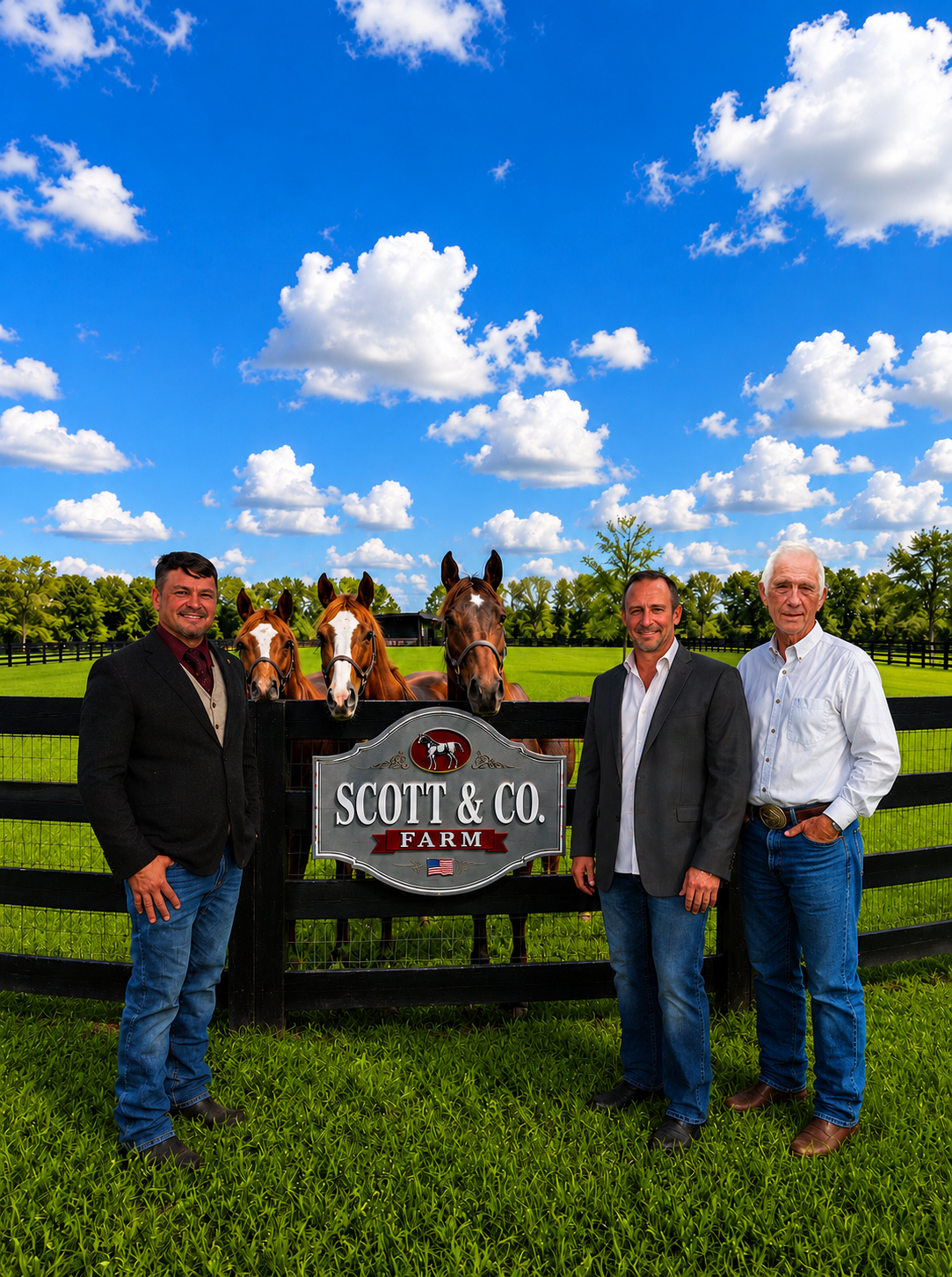
Left to right: Duane Scott, horses Metairie, Incognito Burrito and Kalil, Barry Scott and Ray Scott.
One of the many things that makes horse racing special is that it’s perfectly suited for families to enjoy. Go to the track any weekend, and you are sure to see kids having a blast running around the apron. Head over to the winner’s circle, and you are likely to see two or maybe three generations of horsemen celebrating a victory. For Barry Scott, his brother, Duane, and their father, Ray, breeding Louisiana-breds gives them an added reason to maintain their family ties, and they are in the midst of their greatest success yet with Kalil.
The story of the now 4-year-old Louisiana-bred filly by Practical Joke started back in 2017, when the Scotts picked the Smart Strike mare Hatpin out of the Keeneland November Breeding Stock Sale for $30,000 as they transitioned from owners to breeders. The stakes-winning broodmare was sold in foal to 2016 Eclipse Champion Male Turf Horse Flintshire (GB), and the resulting Louisiana-bred, named Hotpin, went on to become a winner while running for the Scotts.
But the big score with Hatpin didn’t come until 2023, when the Scotts, who breed under the name Scott & Company Farm LLC, sold her Practical Joke filly named Kalil to Jake and Jeff Delhomme’s Set-Hut LLC for $57,000 at the Breeders Sales Company of Louisiana Yearling and Mixed Sale. That itself was a nice result, and it continues to pay dividends thanks to the Louisiana breeders’ awards as Kalil has developed into a stakes winner with earnings of $230,660 and counting.
Metairie is another success story for the Scotts, as the 2022 Louisiana-bred gelding by Hard Spun brought $25,000 at the same sale. After going winless in his first seven starts, Metairie stamped himself as one to watch with a maiden victory on April 29 followed by a first-level allowance score on June 4, both at Evangeline Downs. His earnings now stand at $61,440.
While the Scotts sell most of what they breed at auction, they did race another Practical Joke filly named Incognito Burrito with success. After not meeting her reserve at the Keeneland September Yearling Sale, the Louisiana-bred earned more than $100,000 for the Scotts while racing against allowance and stakes company in Louisiana. She now runs for Bankroll Racing Stable LLC after being claimed from the Scotts for $25,000 in January of this year at Delta Downs. The 4-year-old filly has since run second or third in four straight starts and boosted her bankroll to $142,690.
“The best thing we ever did was start consigning our own horses and doing it in Louisiana and getting them with Louisiana trainers and collecting breeder’ awards.” ~ Barry Scott
Breeding to sell at auction is always fraught with uncertainty. If you sell a yearling for $10,000 and it turns into a Grade 1 winner, there is sure to be at least a tinge of regret. Of course, the flip side is that you might sell one for $100,000 that prefers to run with his friends at the back of the pack rather than win a race. Barry says he’s confident that they made the right decision in switching from owning horses on the track to breeding them on his and his father’s farms in the southern part of the state. Barry’s farm is about 15 acres, and Ray’s covers some 30 acres about a 45-minute drive away.
“That’s the beauty of breeding in Louisiana, you still feel like you own the horse because you get 20-percent breeders’ awards or 25-percent* if it’s a Louisiana stallion,” said Barry about why he now prefers breeding over owning. “I went to the race when Kalil won her stakes race (the $100,000 Louisiana Legends Turf Distaff Stakes on June 6 at Evangeline Downs). I got in the picture, and it was like I still owned her. I felt like I was talking to Jake about what we’re going to do next with her.
“Even though she’s not mine anymore, it kind of feels that way,” he added. “That’s one of the things that got us into being breeders. The breeders’ awards are so special in Louisiana,”
The Scotts have been breeding long enough now that they can rely on their own knowledge and experience in addition to what they learned from others early on. And they see their two farm locations as an advantage because it allows them to rotate pastures and horses depending on the time of year.
“It lets us to be able to take care of our pastures really well, where we can rotate pastures,” said Barry. “We can plant Bermuda grass, get it going well in the winter, then get our rye going, and so we always have pastures that are resting, and we can move the horses into fresh Bermuda or fresh ryegrass. To me, that is one of the biggest things about raising racehorses. Making sure that they’re healthy and they’ve been raised on the right nutrition, and grass is a huge part of that.”
Like many others in the industry, the Scotts grew up with horses but not necessarily with a focus on Thoroughbred racing.
“My dad didn’t ride but we rode barrel horses when we were around 10 years old, and after that we started bull riding. All three of us are State Farm agents, or were State Farm agents, so we did that together for years,” Barry said.
After getting his career established in the insurance industry, Barry started to look for something to do as a diversion outside of work. He was drawn back into horses, but this time, the racing kind.
“One of my friends wanted to go to the races one night, and I hadn’t been since I was a kid and might had been to the races only four or five times in my life at that point,” Barry said about his entrance into the sport. “So I went with him, and I knew (trainer) Sam Breaux because they used to babysit me when I was a kid, and I saw him out there winning almost every race.
“I wind up going to my daddy and saying, ‘Dad, what do you think about getting a racehorse?’ And so he says, ‘Well, we can try it.’
The Scotts connected with Breaux, who had an owner looking to sell a horse cheap, and for $1,000 they got their first racehorse in 2009. That horse, a Louisiana-bred named Red Briar, ran about how you might expect a $1,000 horse to run. He didn’t win a race for the Scotts, but the gelding did hit the board a few times and before long the family had a stable of racehorses.
“Racing them, it was fun,” said Scott, who said that he and his father’s racing operation was winning dozens of races per year, along with some stakes, before transitioning to breeding around 2016 and bringing Duane into the partnership. “I tell you, raising them from when they’re babies, and going to Keeneland, picking the mares out, it’s really been a fun thing and a rewarding hobby for us.
“We got a lot of help from different people, like Josh Stevens, Andrew Carey and David Tillson,” he added. “But after a while, you just got to kind of figure it out on your own and do it yourself. At first, we were trying to go to Kentucky and sell horses, but we just don’t have the pockets to do that. The best thing we ever did was start consigning our own horses and doing it in Louisiana and getting them with Louisiana trainers and collecting breeder’ awards.”
Barry said they end up with about six or seven foals a year, which is about all they can handle as a family-run operation.
The Scotts had a successful run as owners, and now they have hit their stride as breeders. And while the success of a stakes winner like Kalil is great, that perhaps comes second to the experience of two sons and their father raising a Louisiana-bred foal and watching it hit the track, regardless of the result.
“This is a real special thing for us, doing it with my dad and my brother,” added Barry. “I’m 50 years old, my daddy’s 80 years old, and my brother’s 52. We’ve always done things together, but this may be one of the last things that we are able to do as a partnership and a family. Hopefully, we can continue doing it.”
Everyone is busy and distractions are plentiful in today’s world, but the Scotts are thankful for the horses that bring them together.
“I talk to my daddy at least every other day, and we have conference calls to talk about the horses,” Barry added. “That keeps me, my daddy and my brother talking as a family, whereas it wasn’t for the horses, you don’t have as much to talk about. When you’ve got 20 horses with mares, weanlings and yearlings, you’re gonna have to talk a lot. I think that was a big part of why we did this. It really keeps us engaged as a family.”
Editor’s note: Beginning October 1, 2026, Louisiana Breeders Awards will be adjusted slightly due to a decrease in funds related to the discontinuation of Historial Horse Racing (HHR). For more information, refer to letter from LTBA President Keith Hernandez